Telecommunications Explained: A Guide to Latency, Ping & Jitter

Internet in Portugal: The Ultimate 2026 Guide for Expats & Nomads
February 9, 2026
You pay for a high-speed fibre plan, yet your crucial video calls freeze and your game lags at the worst possible moment. It’s a common frustration. The truth is, a superior online experience goes far beyond download speeds. To truly understand your connection quality, you need to look past the headline numbers and into the core metrics that define modern telecomunicações-the details that separate standard internet from a truly smart, reliable service.
This guide is designed to empower you. We’ll demystify the three critical factors that truly impact your daily digital life: latency, ping, and jitter. You’ll finally understand why your connection can feel sluggish, learn how to confidently diagnose the real cause of lag, and discover what to look for in an internet provider that delivers a seamlessly powerful connection for gaming, streaming, and working from home. It’s time to unlock the full potential of your Smart Internet and connect to a world of new possibilities.
Beyond Speed: What is Telecommunications Quality in 2026?
In today’s hyper-connected world, the conversation around internet service has been dominated by one thing: speed. We see massive numbers advertised-500 Mbps, 1 Gbps-and assume bigger is always better. But the future of high-performance telecomunicações isn’t just about raw speed. It’s about quality. It’s the science of how data travels from a server to your screen, and the stability of that journey.
Have you ever been on a supposedly “fast” 500 Mbps plan, yet your video calls stutter and your online games lag? That’s because you’re experiencing a quality issue, not a speed issue. A stable, intelligent 100 Mbps fibre connection can deliver a far superior experience than a volatile, high-bandwidth plan. True Smart Internet performance is built on three pillars that define a high-quality connection: latency, ping, and jitter. Understanding these core network performance metrics is the key to unlocking a truly seamless online life.
Bandwidth vs. Quality: A Simple Analogy
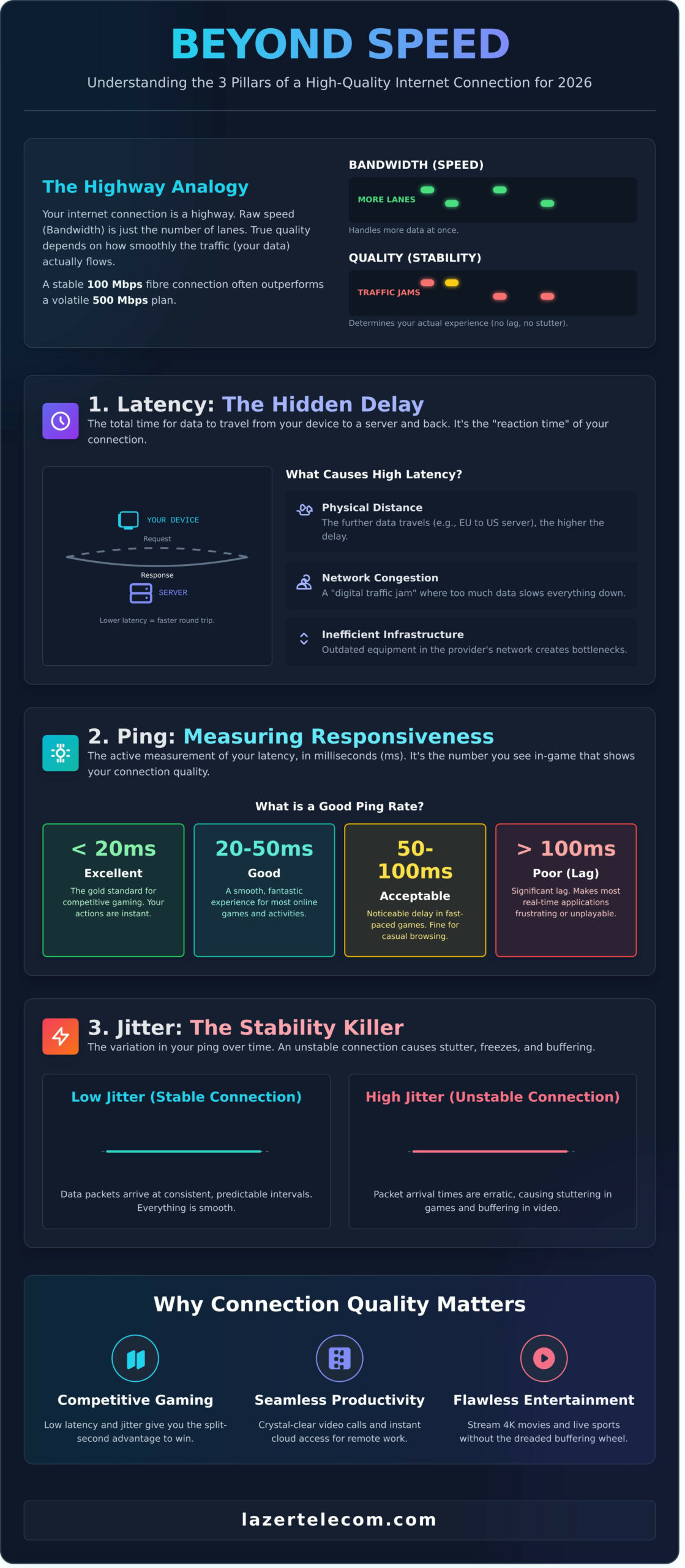
Imagine your internet connection is a highway. Bandwidth (Mbps) is the number of lanes available. More lanes can handle more cars (data) at once. But quality is what determines your actual travel time. Latency and ping are the speed limit and traffic conditions-even on an eight-lane highway, you won’t get anywhere fast in a traffic jam. Jitter is like unpredictable drivers who brake suddenly, causing frustrating slowdowns and an inconsistent journey.
Why This Matters for You
This shift from quantity to quality in telecomunicações has a direct impact on your daily digital experiences. A high-quality connection is the difference between frustration and flow, ensuring:
- Competitive Gaming: Every millisecond counts. Low latency means your actions are registered instantly, giving you the edge.
- Seamless Productivity: For remote work, a stable connection means crystal-clear video calls and instant access to cloud files. This is crucial for creative teams, where digital collaboration must align with physical production timelines, often coordinated with a dedicated imprenta para agencias de publicidad to meet campaign deadlines.
- Flawless Entertainment: Stream your favourite 4K series or live sports events without the dreaded buffering wheel interrupting the best moments.
In 2026, it’s not about having the widest highway; it’s about having the smartest, most reliable one.
Latency Explained: The Hidden Delay in Your Connection
Think of latency as the reaction time of your internet connection. In the world of telecomunicações, it’s the total time it takes for a data packet to travel from your device to a server and for the server’s response to travel back. Imagine sending a letter across the country and waiting for a reply to arrive-latency is that entire round-trip delay. While often confused with speed (bandwidth), understanding what is network latency is the first step to unlocking a truly seamless and responsive online experience.
The single biggest factor dictating latency is physical distance. Data travels incredibly fast, but it’s not instantaneous. Sending a signal from Lisbon to a server in Tokyo will always have more inherent delay than connecting to one in Madrid. However, the technology used for the journey matters immensely. Lazer’s next-generation fibre-optic network transmits data as pulses of light, offering the lowest possible latency compared to older copper cable or wireless 4G connections, which are more susceptible to interference and delays.
What Causes High Latency?
Beyond the fundamental limit of distance, several factors can introduce frustrating delays into your connection. A high-performance network is engineered to minimise these bottlenecks, but it’s smart to know what they are:
- Physical Distance: The further your data has to travel, the higher the latency. Gaming on a US server from Europe is a classic example of distance-induced lag.
- Network Congestion: Think of it as a digital traffic jam. When too many users try to use the same network path, your data packets can get slowed down or delayed.
- Inefficient Infrastructure: Outdated or poorly maintained equipment within an Internet Service Provider’s (ISP) network can create bottlenecks, adding unnecessary milliseconds to your connection’s round-trip time.
The Real-World Impact of Latency
High latency isn’t just a gamer’s problem; it’s a drag on your entire digital life. For web browsing, it’s that frustrating pause before a page even begins to load. On video calls, it creates that awkward, talk-over-each-other delay that disrupts natural conversation. In high-stakes environments like financial trading, where transactions happen in microseconds, low latency isn’t just an advantage-it’s absolutely critical for success.
Ping Demystified: How We Measure Your Connection’s Responsiveness
If latency is the technical delay, then ping is its real-world measurement. Think of it as a quick, active test of your connection’s reaction time. Your device sends a tiny packet of data-an ICMP echo request-to a game server, which then sends it back. Ping is the total time this round trip takes, measured in milliseconds (ms). For gamers, this number is everything.
A high ping is a direct symptom of high latency, and it’s the number you see in-game that tells you whether your connection is ready for battle. Achieving a low, stable ping is the first step to unlocking a seamless, competitive gaming experience and leaving frustration behind.
What is a Good Ping Rate?
Understanding ping values helps you gauge your connection’s performance instantly. Here’s a simple breakdown of what to aim for:
- Excellent (<20ms): The gold standard. This is ideal for professional and competitive gaming where every millisecond gives you an edge.
- Good (20-50ms): A fantastic experience for most online games. Your actions will feel instantaneous and smooth.
- Acceptable (50-100ms): You might notice a slight delay, especially in fast-paced games. It’s generally fine for casual gaming and web browsing.
- Poor (>100ms): This is where you experience significant lag. It’s frustrating for any real-time application and can make gaming unplayable.
How Ping Affects Your Gaming Experience
High ping is the direct cause of what gamers call ‘lag’-the infuriating delay between when you press a button and when your character performs the action on screen. In a first-person shooter, this could mean you lose a firefight because your opponent sees you fractions of a second before you see them. In a racing game, it could be the difference between a perfect turn and crashing into a wall. This is why choosing a game server physically closer to your location in Portugal often helps, as it shortens the distance the data has to travel.
Ping vs. Bandwidth for Gamers
Many people mistakenly believe that a faster download speed (bandwidth) is the key to better gaming. However, for online gaming, responsiveness is far more important. A stable 25 Mbps fibre connection with a 15ms ping will deliver a vastly superior gaming experience than a 500 Mbps connection with a 120ms ping. Gaming itself uses very little data; it’s the speed and reliability of that data exchange that matters. When choosing between telecomunicações providers, a gamer’s focus should always be on the quality and stability of the connection, not just the headline speed.
Understanding Jitter: The Enemy of Smooth Streaming and Calls
If latency is the delay, jitter is the chaos. In simple terms, jitter is the variation in your ping over time. It’s not about how long a data packet takes to travel, but how inconsistent that travel time is. A low, stable ping is great, but if it suddenly spikes and drops unpredictably, you’re experiencing high jitter.
Think of it like a musician’s beat. A perfect connection has a steady, reliable rhythm. High jitter is like a drummer who can’t keep time-the beat is erratic, unpredictable, and throws everything off. For real-time applications, this instability can be even more disruptive than a consistently high ping. This is a critical challenge that advanced telecomunicações solutions aim to solve.
What Causes High Jitter?
Jitter isn’t a random problem; it’s usually caused by bottlenecks in your connection. The most common culprits behind those frustrating inconsistencies include:
- Network Congestion: When too many people in your area are online, the digital “highway” gets crowded, causing data packets to arrive at irregular intervals.
- Poor Wi-Fi Signal: Physical distance from your router, walls, or interference from other devices can disrupt the stability of your connection.
- Overloaded Hardware: An old or low-quality router can struggle to manage traffic efficiently, leading to an unstable data flow within your own home.
The Real-World Impact of Jitter
An unstable connection manifests in the most annoying ways, turning seamless digital experiences into a mess. High jitter is the direct cause of:
- Video Calls: Voices sounding robotic, video freezing while the audio continues, and calls dropping at the worst possible moment.
- Music Streaming: Unwanted gaps or stutters that ruin the flow of your favourite album or podcast.
- Online Gaming: The ultimate frustration for gamers. Jitter causes unpredictable lag spikes, your character “warping” or teleporting, and actions that don’t register in time.
Tired of an unpredictable connection holding you back? A stable, intelligent network is the answer. Experiencing these issues? Discover Lazer’s Smart Internet for ultimate stability.
How to Test and Improve Your Telecommunications Quality
In the world of competitive gaming and seamless 4K streaming, raw speed is only half the story. A truly superior connection is defined by its stability-the low latency and minimal jitter that deliver a flawless, responsive experience. Understanding your connection’s real performance is the first step to unlocking its full potential. When it comes to high-performance telecomunicações, stability is the new speed.
Testing Your Connection Like a Pro
To get an accurate picture of your internet health, use a comprehensive tool like Cloudflare’s Internet Speed Test or Ookla’s Speedtest.net. Don’t just glance at the large download number; focus on the metrics that matter for real-time applications:
- Ping (Latency): This is your reaction time. For gaming, anything under 40ms is good, and under 20ms is elite.
- Jitter: This measures connection consistency. A jitter value below 10ms is excellent and means you won’t experience annoying lag spikes.
For the most reliable results, always test with a device connected directly to your router with an Ethernet cable. This gives you a true baseline of your service, free from Wi-Fi interference.
Actionable Steps for Lower Ping and Jitter
Ready to take control? These simple, effective steps can dramatically improve your connection’s quality and give you a competitive edge.
- Go Wired: An Ethernet cable provides a more stable and faster connection than Wi-Fi, drastically reducing both ping and jitter. This is the single best upgrade for any serious gamer or remote worker.
- Optimise Your Wi-Fi: If a wired connection isn’t possible, move closer to your router. For larger homes, upgrading to an intelligent Mesh Wi-Fi system eliminates dead zones and ensures a strong, stable signal everywhere.
- Reboot Your Router: A simple weekly restart clears your router’s memory, resolves temporary glitches, and can instantly improve performance.
- Choose a Superior Provider: Ultimately, your connection is only as good as the infrastructure behind it. Modern 100% fibre networks, like those offered by Lazer Telecom, are engineered for the ultra-low latency that today’s digital life demands.
If your current telecomunicações provider struggles with stability, it’s a sign that their network isn’t built for the future. Experience the power of Smart Internet and feel the difference that a true fibre connection makes.
Unlock a Seamless Digital Future
As we move beyond a simple focus on speed, it’s clear that true digital performance lies in the details. A truly superior online experience-whether you’re leading a team remotely, conquering a virtual battlefield, or streaming in perfect clarity-is defined by low latency, a responsive ping, and zero jitter. Understanding these core metrics empowers you to demand a higher standard from your telecomunicações service and refuse to let lag dictate your potential.
Why settle for a connection that can’t keep up? Lazer’s next-generation fibre network was built from the ground up for the low latency and stability that modern life demands. Trusted by the most demanding gamers and remote workers across the Algarve, our Smart Wi-Fi solutions deliver intelligent, whole-home coverage without compromise. It’s time to stop troubleshooting and start experiencing. Check coverage for Lazer’s high-quality fibre internet in your area and step into a smarter, faster future.
Frequently Asked Questions
Does fibre optic internet have lower ping and latency?
Absolutely. Fibre optic technology transmits data as pulses of light, which is significantly faster and more stable than older copper cable connections. This next-generation infrastructure dramatically reduces latency, giving you the competitive edge in gaming and ensuring seamless video calls. With a superior fibre connection, you’re not just getting speed; you’re getting the low-ping performance required for the demands of modern digital life and unlocking new possibilities for your home.
Can a VPN affect my latency and jitter?
Yes, a VPN can impact both. By routing your traffic through an extra server, a VPN almost always increases latency and ping. While this secures your data, the added “stop” on the data’s journey can introduce delays. Depending on the VPN server’s quality and location, it can also increase jitter, making your connection less stable. For the best gaming or streaming performance, it’s often recommended to connect directly without a VPN for the lowest possible latency.
Is 100 Mbps fast enough for 4K streaming and online gaming?
A 100 Mbps connection is generally sufficient for 4K streaming on one device and provides enough bandwidth for online gaming. However, the experience depends on how many devices are connected simultaneously. If your household is streaming, gaming, and working from home, you may experience buffering or lag. For a truly seamless, future-proof home, upgrading to a higher-speed fibre plan ensures flawless performance for every user and every device, all at once.
Why is my ping high even though I have a fast internet plan?
High speed (bandwidth) doesn’t guarantee low ping (latency). Bandwidth is how much data you can transfer, while ping is how fast that data travels. High ping can be caused by factors like geographical distance to the server, network congestion outside your home, or using Wi-Fi instead of a wired Ethernet connection. This is a common issue in the world of telecomunicações, but a quality fibre connection provides the most stable foundation for reducing latency.
How can I check the ping to a specific game server?
Most online games display your ping to the server directly within their interface, often in the network settings or on the score screen. For a more technical approach, you can find the game server’s IP address (often available on forums or fan sites) and use the “ping” command in your computer’s Command Prompt (Windows) or Terminal (Mac). This gives you a direct, real-time measurement of the round-trip time from your device to the server.
Will a better router reduce my jitter and improve call quality?
A modern, intelligent router can make a significant difference. Older or basic routers can struggle with managing traffic from multiple devices, leading to high jitter. Upgrading to a router with modern features like Quality of Service (QoS) and combining it with intelligent Wi-Fi mesh technology ensures stable, prioritized connections. This results in crystal-clear calls and a smoother online experience, a key goal for any advanced telecomunicações provider aiming for superior service.